
For decades, psychedelics were discussed almost exclusively through the language of prohibition, criminalization, and cultural fear. Today, the conversation is changing. Researchers, universities, veterans’ organizations, mental-health professionals, federal agencies, and political leaders from both parties are asking a question that was nearly impossible to raise publicly a generation ago: What if substances once dismissed as having no legitimate value may hold carefully regulated potential for people suffering from depression, post-traumatic stress disorder, addiction, and other serious conditions? The answer has not yet been settled. But the federal government is no longer refusing to ask the question.
The Door Began Reopening in the 90’s
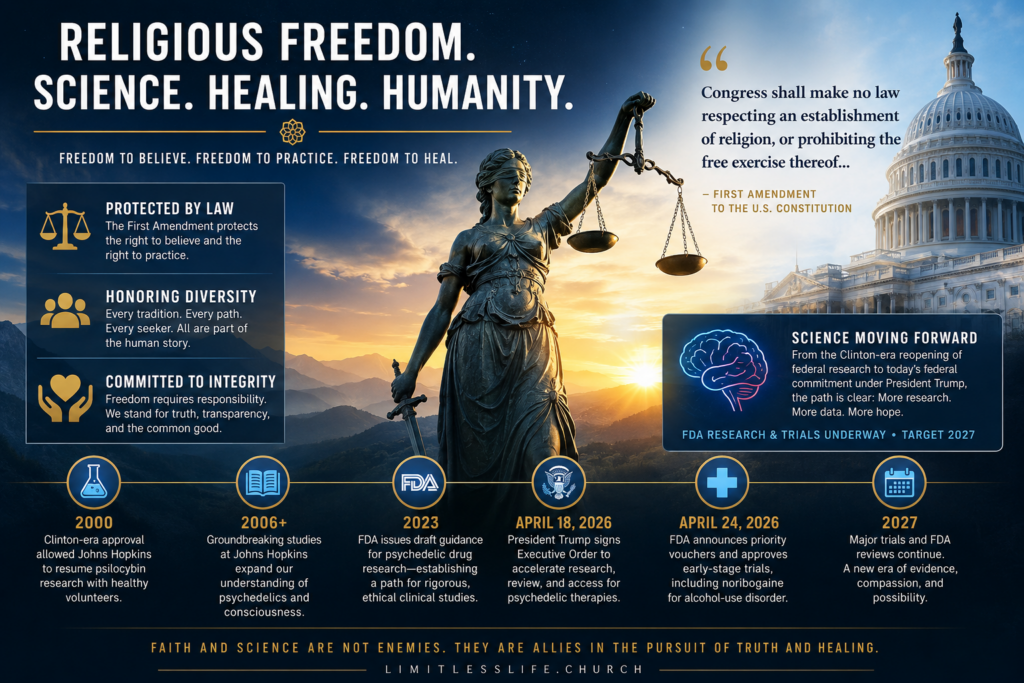
It would be historically inaccurate to claim that President Bill Clinton personally endorsed psychedelic therapy. The significant development during his presidency was regulatory rather than presidential. In 2000, during the final year of the Clinton administration, researchers at Johns Hopkins received federal regulatory approval to resume psychedelic research involving healthy volunteers who had no previous psychedelic experience. Johns Hopkins describes this as a landmark moment in the modern return of American psychedelic research.
That approval did not legalize psilocybin or authorize public use. It allowed serious researchers to begin studying these substances again under controlled conditions. The Johns Hopkins program eventually produced a landmark 2006 study examining psilocybin experiences and their lasting personal and spiritual significance. The university now operates one of the world’s leading centers dedicated to psychedelic and consciousness research. This distinction matters. The modern psychedelic movement did not begin with a sudden declaration that these substances were safe, harmless, or universally beneficial. It began when regulators allowed qualified scientists to investigate them rather than permitting political stigma to end the discussion. Science was allowed back into the room.
As research expanded, the Food and Drug Administration began creating a clearer regulatory framework for psychedelic drug development. In June 2023, the FDA issued its first draft guidance specifically addressing clinical investigations involving psychedelic drugs. The guidance included psilocybin and LSD, along with substances such as MDMA, and addressed the unique problems researchers face when designing controlled studies involving profound changes in perception and consciousness.
The guidance did not declare these treatments effective. It did something equally important: it recognized psychedelic drug development as a legitimate field requiring rigorous standards for study design, safety monitoring, data collection, and patient protection. That is how responsible progress occurs. Not through blind enthusiasm. Not through automatic rejection. Through evidence.
President Trump Makes Federal Support Explicit
On April 18, 2026, President Donald Trump signed an executive order directing federal agencies to accelerate research, regulatory review, and appropriate access pathways for psychedelic drugs being investigated as treatments for serious mental illness.
The order specifically states that psychedelic drugs, including ibogaine-related compounds, have shown potential in clinical studies for patients whose conditions persist despite standard treatments. It declared that accelerating innovative research and appropriate drug approvals would be official administration policy. The order included the FDA to prioritize qualifying psychedelic products that had received Breakthrough Therapy designation. It also instructed federal health agencies to increase clinical-trial participation, improve data sharing, develop real-world evidence, and coordinate with the Department of Veterans Affairs and private researchers.
Trump’s order also directed at least $50 million toward federal and state collaboration involving psychedelic research programs for serious mental-health conditions. This did not amount to blanket legalization. It did not authorize unsupervised personal use. It did not establish that every psychedelic substance is safe or effective. It represented something more disciplined: a presidential directive that potential treatments should be investigated urgently rather than rejected merely because they are unconventional.
The FDA Is Already Acting
Six days after the executive order, the FDA announced several concrete regulatory actions.
The agency issued national priority vouchers connected to research involving:
• Psilocybin for treatment-resistant depression
• Psilocybin for major depressive disorder
• Methylone for post-traumatic stress disorder
The FDA also allowed an early-stage American clinical study of noribogaine hydrochloride, a compound related to ibogaine, to move forward as a potential treatment for alcohol-use disorder. According to the agency, this was the first time it had allowed a U.S. clinical study involving an ibogaine derivative. The FDA emphasized that permission to conduct a trial is not approval of the drug. It means researchers may proceed under strict regulatory oversight while gathering evidence about safety, dosage, risks, and possible effectiveness. That is an essential difference. Research is not approval. Potential is not proof. Hope is not a substitute for evidence.
What Is Expected in 2027?
The year 2027 could become an important milestone, but it should not be presented as a guaranteed FDA approval date. Several advanced psychedelic-development programs are moving through late-stage trials or regulatory review extending into 2027. Compass Pathways has reported that a rolling New Drug Application and initial FDA review are underway for COMP360, its synthetic psilocybin formulation for treatment-resistant depression. The company expects to complete its submission in late 2026 and is preparing for a possible launch during the first half of 2027—but only if the FDA approves the product and the Drug Enforcement Administration completes the necessary rescheduling. Other Phase 3 research involving psilocybin-related compounds also lists estimated study completion dates during 2027. The accurate statement is therefore not that the FDA has promised to approve psychedelics in 2027. The accurate statement is that major clinical trials and regulatory reviews are underway, and some developers believe an FDA decision or possible regulated launch could occur during 2027. The evidence will decide.
A Bipartisan Cultural Shift
The modern psychedelic-research movement has crossed many traditional political boundaries. Regulatory progress began reemerging during the administrations of both political parties. It continued through university research, FDA guidance, congressional interest, veteran advocacy, nonprofit investment, and private clinical development. The Trump administration’s 2026 executive order made the federal shift unmistakable, but the scientific foundation was built across decades. This should not become another partisan trophy. Depression is not Republican. PTSD is not Democratic. Addiction does not check voter registration.
Veterans, families, first responders, survivors of trauma, and people living with treatment-resistant mental illness deserve research that is protected from both political hysteria and commercial hype.
Medical Research and Religious Practice Are Different Questions
The expansion of psychedelic medical research does not automatically establish legal protection for religious sacramental use. FDA approval addresses whether a particular manufactured drug product has demonstrated safety and effectiveness for a specific medical condition. Religious-liberty claims involve different legal questions, including sincerity, established belief, religious exercise, governmental burden, public safety, and possible accommodation. The two conversations can influence one another culturally, but they are not legally interchangeable.
Scientific research may challenge the outdated claim that psychedelics have no conceivable value. It may also provide better information about risks, screening, dosage, contraindications, preparation, supervision, and long-term outcomes. But neither an executive order nor an FDA clinical trial creates an automatic exemption from federal or state controlled-substance laws. Responsible communities must understand that distinction.
We Should Not Fear Honest Investigation
For too long, American drug policy frequently began with a conclusion and then refused to examine the evidence. That approach is changing. The federal government is now openly acknowledging that psychedelic compounds may deserve serious investigation as potential treatments for some of the most difficult mental-health and substance-use conditions facing the nation. That does not mean every promise will be fulfilled. Some treatments may fail. Some may prove too dangerous. Some may work only for carefully selected patients within highly structured environments. Others may eventually transform the way certain conditions are treated. We do not yet know. That is precisely why the research matters.
A mature society should be capable of holding two truths at once: Psychedelics can carry real risks. They may also hold real potential. The responsible path is neither reckless celebration nor fear-driven prohibition. It is courageous, transparent, ethical investigation. The door that began reopening during the Clinton era is now being pushed wider by universities, scientists, regulators, advocates, and a direct presidential order. The journey toward 2027 is not a promise of approval. It is proof that the question can no longer be dismissed.
This article is provided for educational purposes and does not constitute medical or legal advice. Psychedelic substances remain controlled under federal law except within authorized research, approved medical, or legally recognized circumstances.